
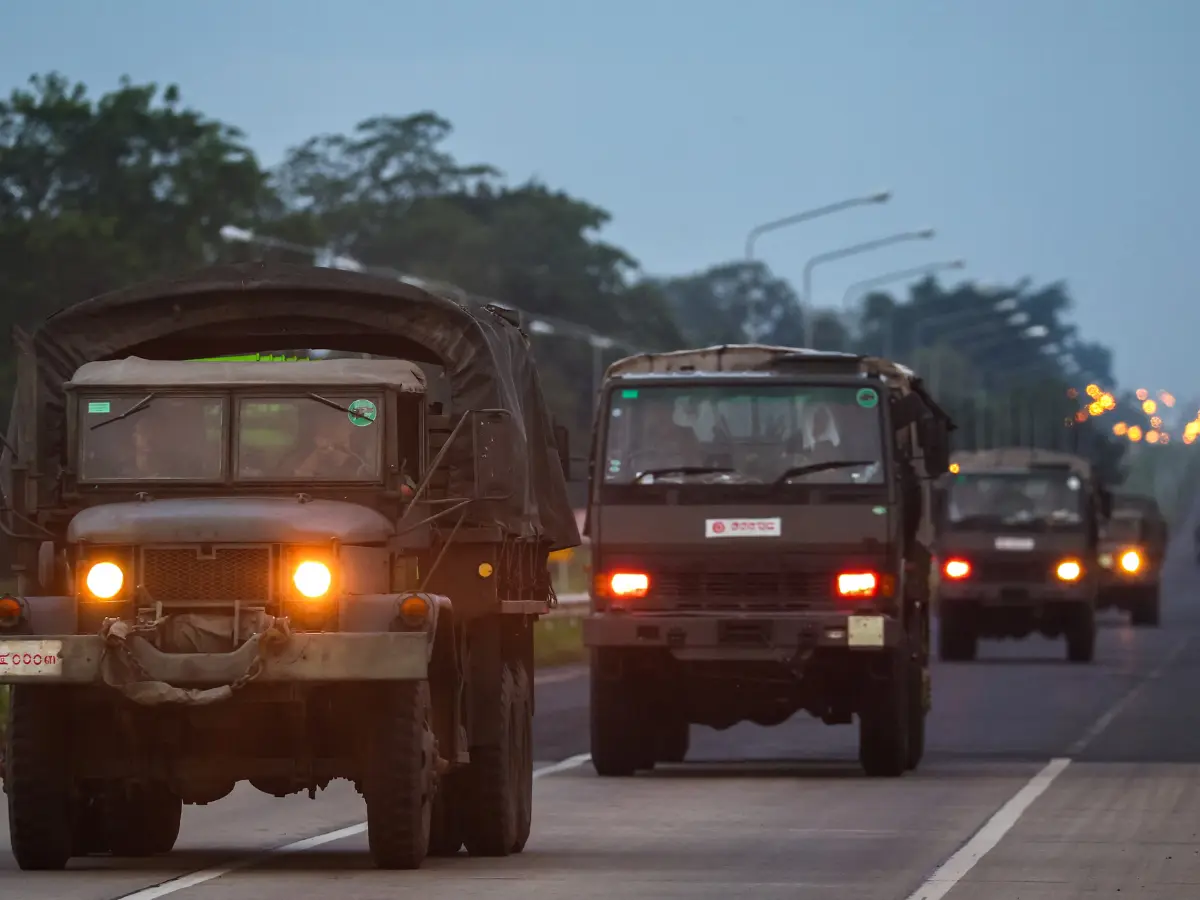
Despite a ceasefire agreement that took effect at midnight on 28 July, the Royal Thai Army has condemned a series of alleged violations by Cambodian forces in several volatile sectors along the Thai-Cambodian border. The Thai military reported continued hostile actions by Cambodian troops across four areas in Si Sa Ket and Surin provinces, with accusations ranging from troop reinforcements to mortar attacks and uncoordinated diplomatic visits. However, in a statement, the Cambodian foreign ministry has categorically rejected the allegations and called the claims ‘fabricated.’
Thailand and Cambodian leaders in Malaysia agreed to an immediate and unconditional ceasefire to end their recent border clashes. US officials were also present as Malaysia’s PM Anwar Ibrahim, Cambodia’s PM Hun Manet and Thailand’s acting PM Phumtham Wechayachai addressed the media. Though it was agreed that the military commanders of Thailand and Cambodia would hold an informal meeting, followed by a meeting of defence attaches, led by the chairman of ASEAN, on August 4, clashes and violations seem to have continued.
Multiple Flashpoints Reported
According to a detailed statement issued by the Royal Thai Army at 10:00 hours on 30 July, Cambodian forces engaged in provocative military activity. In the Chong Kanma and Phu Makua area of Si Sa Ket Province, Thai authorities reported late-night drone reconnaissance flights and increased troop presence on the Cambodian side. A small-arms engagement broke out between 21:30 and 22:00 hrs on 29 July, with both sides exchanging fire. Further south, in the Phra Viharn–Phu Makua/Huay Ta Maria region, Cambodian forces allegedly launched sustained attacks using small arms and grenade launchers starting at 22:00 hrs on 29 July, continuing into the early hours of 30 July. The Royal Thai Army stated it responded in self-defense, “in accordance with international law.” At approximately 05:17 hrs on 30 July, Thai military positions at Pha Mo E-Daeng, also in Si Sa Ket Province, came under indirect fire from multiple mortar rounds reportedly launched from Cambodian territory. While no casualties were reported, Thai forces did not retaliate, citing a desire to uphold the ceasefire. In the Ta Muen Thom–Ta Kwai temple complex in Surin Province, Thai surveillance detected unusual troop movements by Cambodian forces near the archaeological site. The area, historically sensitive due to overlapping territorial claims and its cultural significance, remains under close watch by Thai authorities.
Adding to tensions, Cambodian Defense Attaché officials led a group of foreign defence and military attachés, as well as members of the media, to the Chong Ahn Ma Check Point in Nam Yuen District, Ubon Ratchathani Province. The Royal Thai Army criticised the visit as being carried out without prior notification and warned that bringing foreign personnel into a high-risk zone posed “serious safety concerns.” Meetings between rival commanders along the border – scheduled as part of the pact – went ahead, with Thailand’s army saying de-escalation steps were agreed, including “a halt on troop reinforcements or movements that could lead to misunderstandings”.
Thai Response and Warnings
The Royal Thai Army reaffirmed Thailand’s full compliance with the ceasefire agreement and stressed that all Thai military actions have been suspended in good faith since the ceasefire took effect. However, it condemned what it termed “reckless and irresponsible actions” by Cambodian forces. “The Royal Thai Army condemns these repeated violations and reaffirms Thailand’s adherence to peace, restraint, and humanitarian principles,” the statement said. “Should these violations persist, Thailand will take appropriate and decisive measures.”
The continued hostilities come amid growing concerns over the fragility of the ceasefire, which was brokered after weeks of heightened border tension and sporadic clashes between the two Southeast Asian neighbours. As of now, there has been no official response from the Cambodian government regarding the Thai Army’s allegations.
Thailand-Cambodia conflict
Thailand and Cambodia engaged in their worst fighting in over a decade this week, exchanging heavy artillery fire across their disputed border. Clashes broke out between the two countries early on Thursday (July 24) along a disputed area abutting an ancient temple, rapidly spilling over to other areas along the contested frontier and heavy artillery exchanges continued for a third straight day. The latest tensions rose over an 11th-century Hindu temple called Preah Vihear, or Khao Phra Viharn in Thailand – with both Bangkok and Phnom Penh claiming historical ownership over it. Tensions began rising between the Southeast Asian neighbours since May this year, following the killing of a Cambodian soldier during a brief exchange of gunfire. The incident triggered diplomatic spats, ultimately leading to armed clashes.
Thailand and Cambodia have for more than a century contested sovereignty at various un-demarcated points along their 817 km (508 miles) land border, which was first mapped by France in 1907 when Cambodia was its colony. That map, which Thailand later contested, was based on an agreement that the border would be demarcated along the natural watershed line between the two countries. In 2000, the two countries agreed to establish a Joint Boundary Commission to peacefully address overlapping claims, but little progress has been made towards settling disputes.
link